What an EICR is and who needs one
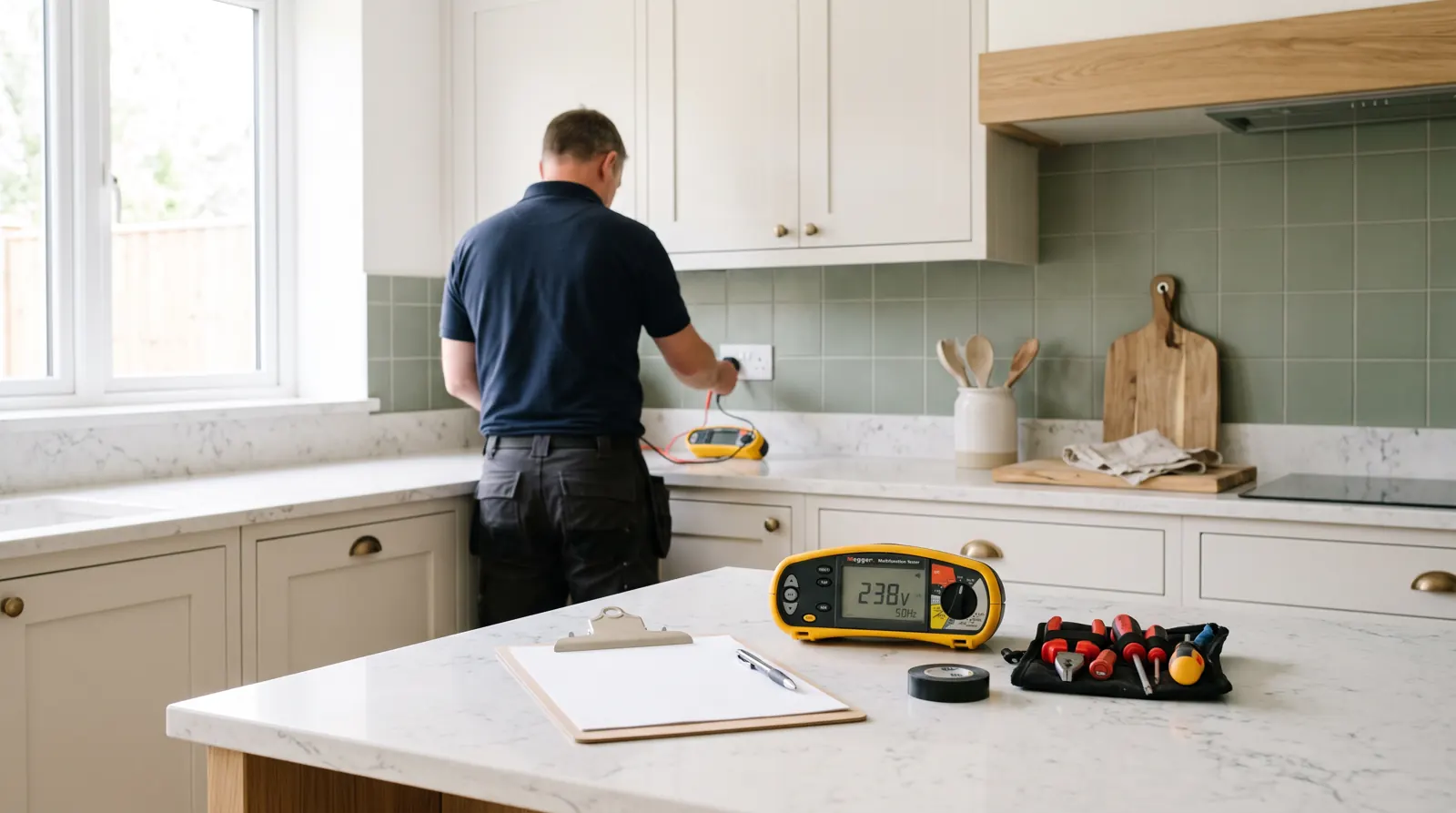
An EICR is a formal inspection of your commercial premises’ fixed wiring, typically completed by us in 1–3 hours and from £250, assessing safety and compliance against current standards.
We inspect the consumer unit, circuits, sockets, lighting and earthing arrangements, checking for damage, deterioration, overloading and defects that could create risk. We record findings, issue clear observations and classification codes (C1, C2, FI) so you can prioritise remedial work.
You’ll need an EICR if you’re responsible for a shop, office, warehouse, workshop, hospitality venue or other business premises. While there’s no statutory inspection interval for commercial installations, employers and duty holders must maintain electrical safety and meet responsibilities under workplace legislation. An up-to-date report provides evidence of inspection, highlights required remedial work and supports legal compliance to help keep staff, customers and visitors safe.
What an EICR costs in Canterbury
Commercial EICRs in Canterbury are charged per circuit, with fixed written pricing provided before testing so you know the expected cost. Below are our standard charges and what each covers.
| Job | Price | What's included |
|---|---|---|
| Commercial EICR | £30–£50 per circuit | Testing, certificate, VAT, labour |
| Fault finding | £80 per hour | Investigation and diagnosis |
| Emergency call-out | £120 per hour | First hour minimum |
Not included: plaster repairs, decoration, asbestos removal, DNO charges or specialist access equipment.
Do landlords in Canterbury need an EICR?
Landlords in Canterbury who let residential property in England are generally required by the Electrical Safety Standards in the Private Rented Sector (England) Regulations 2020 to have an EICR (electrical inspection report) carried out by a competent person at least every five years and before a new tenancy where specified by the regulations.
You should give an existing tenant a copy of the report within 28 days of it being completed, provide a new tenant with a copy before they move in, and supply the local authority (Canterbury Borough Council) within seven days if it is requested. Keep the report and any evidence of remedial work in case of deposit protection or compliance checks.
If the EICR records C1 (danger present), C2 (potentially dangerous) or FI (further investigation required) observations, those matters must be remedied within the timescales stated in the regulations (often within 28 days, or sooner if the report specifies) and you should provide written confirmation of remedial action to the tenant and the local authority where required. Failure to comply can result in enforcement action and civil penalties under the regulations of up to £40,000 in serious cases, depending on the local authority’s published penalty policy.
If you are unsure how the Regulations apply to your particular property or tenancy, seek specific legal advice or contact the local authority for guidance.
Do you need an EICR to sell your house?
You do not legally need an EICR to sell a house in Canterbury or elsewhere in England. That commonly held belief that an EICR is mandatory for selling is incorrect; there is no statutory duty on a seller to provide an EICR, though a landlord must supply one to tenants when required by law. However, ordering an EICR can give buyers independent evidence of the installation’s condition and highlight safety issues before they become a negotiation point.
We recommend an inspection where the property has an older consumer unit, visibly dated wiring, recent flood exposure or no reliable electrical records. This is especially relevant in Victorian terraces with V.I.R. (vulcanised india rubber) or other rubber-insulated cables and in some post‑war homes that may have aluminium wiring.
An EICR is not normally part of standard mortgage requirements, though a lender, surveyor or buyer may request further electrical evidence if concerns arise. Addressing any observations early can help protect conveyancing timelines, reduce last‑minute delays and support a transparent, safety‑focused sale.
Do businesses need one?
For businesses in Canterbury, fixed wire testing (EICR) is not governed by a single statutory inspection interval; however, employers and duty holders do have a legal duty under the Electricity at Work Regulations 1989 to maintain electrical systems so as to prevent danger. An EICR is a recognised way to show you are managing that duty and to identify electrical risks before they cause harm, disruption or damage.
The often‑quoted five‑year interval for offices, three years for industrial premises and annual testing for higher‑risk environments are recommendations from the IET’s Guidance Note 3, not legal requirements; the appropriate frequency should be determined by a suitable and sufficient risk assessment that reflects your premises, use and environment.
We can provide clear, tailored advice on compliance and record‑keeping. A current report may be requested by insurers, commercial landlords or licensing bodies, so keeping testing records up to date can help meet safety, tenancy and insurance expectations.
What we check
We inspect your installation systematically against relevant safety standards, identifying defects that may require attention. 1. We check the consumer unit, protective devices, earthing and bonding; 2. test cable condition and insulation resistance; 3. examine sockets, switches and accessories. We’ll also look for overheating, damage and signs of unsuitable DIY work.
The consumer unit and protective devices
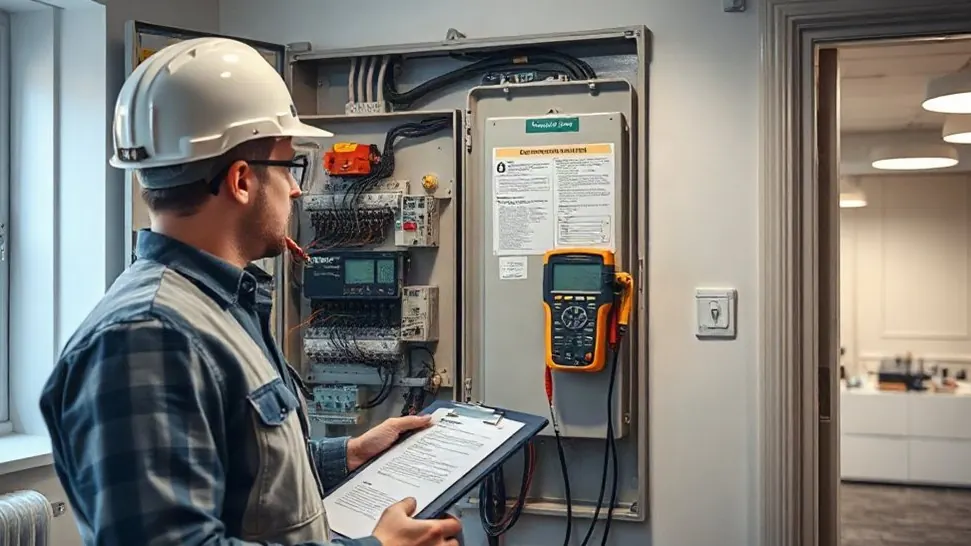
Every commercial EICR includes a close inspection of the consumer unit and its protective devices, as these control how safely circuits disconnect under fault conditions. We check that the enclosure is secure, suitably labelled, free from overheating or damage, and accessible for safe operation and maintenance.
We assess circuit protection ratings, protective device condition, signs of alteration, and whether devices operate within required disconnection times. This includes testing RCDs and RCBOs where fitted, checking that circuit schedules accurately identify each circuit, and identifying obsolete or unsuitable equipment. We also consider whether surge protection is provided where the installation’s risk assessment indicates it is needed. Any defects are recorded using EICR observation codes, so you can prioritise remedial work and maintain a safer commercial installation.
Earthing and bonding
Earthing and bonding are fundamental checks within a commercial EICR because they help protective devices disconnect the supply safely if a fault occurs. We inspect the main earthing terminal, earthing conductor, electrode arrangements where fitted, and connections to confirm they are secure, correctly sized and suitable for the installation’s supply characteristics. We also verify that protective equipotential bonding is present where required, including connections to incoming metal water and gas services. Our testing confirms continuity and measures relevant fault-loop characteristics, helping us assess whether disconnection times can be achieved in accordance with BS 7671. We consider the condition and compatibility of earthing materials, looking for corrosion, damage or unsuitable alterations. We also assess bonding techniques, ensuring clamps, labels and conductor routes provide reliable, accessible connections. Any concern is recorded clearly.
Cable condition and insulation resistance
Cable condition and insulation resistance testing help us identify deterioration that could create shock, fire or supply-reliability risks. We inspect accessible cable routes, terminations and containment for damage, overheating, unsupported runs, poor repairs, moisture ingress and signs of cable ageing. This is particularly important in Canterbury’s older commercial premises, where legacy wiring may require closer assessment.
During insulation testing, we use appropriate test voltages and procedures to measure whether conductors are adequately separated from each other and earth. Low readings can indicate damaged insulation, contamination, damp conditions or hidden faults that need investigation.
Where sensitive equipment could be affected, we’ll isolate or disconnect it in line with safe testing practice. We record results on the EICR, explain any observations clearly, and recommend proportionate remedial work where required to support compliance with BS 7671.
Sockets, switches and accessories
We inspect accessible sockets, switches, fused connection units and other accessories for damage, thanington fittings, overheating, unsuitable locations and signs of poor installation. We confirm that accessories are securely mounted, suitable for their environment and correctly selected for the circuit and connected equipment. In commercial premises, we also consider accessibility, enclosure integrity and whether covers, faceplates and blanking plates are present where required.
We check that socket arrangements, including USB charging units, do not introduce incompatibility or compromise safe operation. Decorative switches are assessed in the same way as standard accessories: appearance doesn’t replace compliance with BS 7671. Where equipment is inaccessible or would require disruption to inspect, we’ll record this clearly within the EICR. Any observed defect is coded according to its potential risk, helping you prioritise remedial work appropriately.
Signs of overheating, damage or DIY work
During a commercial EICR, we look for scorching, discolouration, melted insulation, burning smells, damaged enclosures and thanington or exposed conductors that could indicate overheating or deterioration. We inspect consumer units, distribution equipment, sockets, switches, cable routes and terminations for burn marks, heat damage and thanington connections. These defects can increase fire risk, cause equipment failure or leave people exposed to electric shock.
We also identify apparent DIY alterations, including unsuitable cable types, unsupported wiring, incorrect jointing, missing covers and circuits added without appropriate protection. Work that looks non-compliant isn't automatically unsafe, but we assess it against the requirements of BS 7671 and record any observations accurately. If we find danger, we'll explain the issue clearly, recommend remedial work and advise on any urgent action needed to keep your premises safe.
What the codes mean
We’ll explain each EICR observation code so you can understand the safety priority and required action. C1 and C2 findings require remedial work, while C3 records an improvement recommendation and FI means further investigation is needed. We’ll provide clear findings aligned with BS 7671 and advise you on the appropriate next steps.
| Code | Meaning |
|---|---|
| C1 | Danger present; immediate action required. |
| C2 | Potentially dangerous; urgent remedial work required. |
| C3 | Improvement recommended; not necessarily unsafe. |
| FI | Further investigation required before assessment. |
C1, C2, C3 and FI explained
Although an EICR may identify a range of observations, the code shows how urgently each issue needs attention: C1 means danger is present and requires immediate action, C2 identifies a potentially dangerous defect needing urgent remedial work, C3 records an improvement recommendation, and FI means further investigation is required before the installation’s condition can be confirmed.
We’ll explain each observation clearly and advise on proportionate next steps. C1 and C2 items normally make the report unsatisfactory until rectified; we can isolate an immediate risk where necessary. C3 items don’t require immediate correction, but addressing them can improve safety and compliance. FI isn’t a defect code: it means testing couldn’t establish safety without additional investigation. This can be relevant where Aluminium hazards, concealed cables or alterations from Period rewiring are suspected.
How long it takes and what we need from you
Testing time depends on the size, layout and condition of your premises, but we’ll confirm the expected duration before attendance. Smaller offices or retail units may be completed within a day, while larger, multi-floor or operational sites can require phased testing. We’ll plan work around your occupancy schedule where possible, helping to reduce disruption while maintaining safe isolation procedures.
Before we arrive, please provide clear site access, relevant parking arrangements and keyholder details. We also need access to consumer units, distribution boards, plant rooms, risers and electrical cupboards, plus any areas supplied by fixed wiring. Please tell us about restricted zones, security procedures, alarms, sensitive equipment or times when circuits cannot be isolated. Where access is unavailable, testing may need to be rescheduled or recorded as a limitation on the EICR.
What happens if it fails
If the EICR fails, we’ll normally require remedial work within 28 days and estimate typical repairs from £150 per circuit.
If your commercial EICR identifies unsatisfactory items, we’ll explain each observation, its classification and any immediate safety action required. C1 dangers need urgent attention, and we may advise isolating the affected circuit until it’s made safe. C2 observations require remedial work without delay, while FI items need further investigation before compliance can be confirmed.
We’ll provide a clear report and a practical remediation timeline, prioritising risks to staff, visitors, stock and business continuity. Once the identified work is completed, we can inspect and test the relevant circuits and issue confirmation where appropriate. An unsatisfactory report doesn’t automatically mean your whole premises must close, but unsafe parts must not remain in service. Prompt action also helps address potential insurance implications and demonstrates responsible electrical safety management.
Recent EICRs near Harbledown
We work methodically to identify deterioration, damage, overheating risks and departures from current safety requirements commonly found in the local building stock, such as ageing fabric in Victorian shop conversions or the non‑RCD protected circuits sometimes seen in mid‑20th‑century office refurbishments.
This lets you prioritise urgent issues for specific local property types — for example, updating consumer units in Victorian conversions or replacing ageing wiring in 1960s office blocks — without uncertainty.